Introducing... Alana Clifton-Cunningham

This week CLOG is proud to feature current Gallery 3 exhibitor Alana Clifton-Cunningham, knitter extraordinaire. Based in Sydney where she lectures in Fashion at the University of Technology, Sydney, Alana's artistic practice is an exploration of contemporary knitting, in particular the idea of how knitting is able to deconstruct notions of traditional knitting patterns for the body.

Alana's work is a fantastic display of not only the tactile nature of knitwear, but its sculptural ability as well. Wool is puckered and tightened to create manipulate the surface of the garment, creating a wonderful 3D effect that invites you to touch (well some of them anyway, the other garments are hands off!)

Without further ado, presenting Alana Clifton-Cunningham.

Happy Friday everyone, and see you tomorrow at Craft Hatch at the City Library!

Stomach wrap

About the first time I picked up a pair of knitting needles...
The first time I picked up a pair of knitting needles was when I was about 16 at school, but I quickly put them down again! The second time was at university; knitting was a compulsory component of the degree course where we learnt both hand and machine knitting (using a domestic knitting machine, so very hands on!) The first couple of attempts at knitting at uni were also a bit disastrous, insofar as the knitting would fall off the machine when you were almost at the end etc.

The first thing I made was...
The first thing I recall making at school was a knitted jumper. The first thing I recall making at uni was a knitted vest – very avant-garde in black and white! It was cut away under the bust, skin tight to the hip. From here I continued to explore knitting and majored in it for my final fourth year project. I created a resort wear collection inspired by the travelling circus, so it was quite colourful, with influences of theatrics.

Legwrap and muff

Please describe how you developed and refined your amazing knitting machine skills...
I think I was determined to conquer knitting, so I just kept at it, and before long, I really understood the fundamentals. I was always intrigued by the qualities of knitting, so I guess that helped me to strive to refine it. It also helped when I purchased a knitting machine for home, this gave me the time I needed to practise and develop interesting stitches and outcomes. So yes it was frustrating at first, but became a passion through practice and determination!

Could you please expand upon how body scarification is explored in Visible Markings?
I am interested in identity, and I suppose working with the concept of scarification and knitting, I found the two worked really well together. Knitting conveys so many messages through the stitch patterning and structure, very similar to body scarification, so I liked the idea of combining the two to create a new language. Some of the pieces that I have created for the exhibition look at the concept of knitting as a protective cocoon, other pieces rely comfort, or sexual maturity.

While I have used traditional stitches in some of the pieces, I have tried to reconfigure them through how they have been worked within the piece. Two types of traditional knitting I am particular interested in is Aran and Guernsey knitting.

For Aran knitting, the symbolic nature of the stitch patterns that feature within each sweater can vary from family to family. The amount of patterning that is knitted within an Aran sweater represents the number of males within a particular family group. On a male marriage into a family, the ornate textural pattern for the new member would feature down the centre front of the garment. After the birth of the first son, the design would widen with panels featuring addition design work to signify the expanding family unit. The patterns and motifs were inspired by Celtic metalwork, and is very three dimensional and sculptural in quality, with the patterns being symbolic and tell a story of everyday life.

With Guernsey and Jersey knitting (as known as a ‘fisherman’s’ pullover) the symbolic references of the stitch patterning reflect life by the sea. The coastal villages, which were mostly fishing villages, utilised patterns and motifs designed to represent seascapes and sea-life such as starfish, waves, beach pebbles, ropes, fishing nets, and diamond patterns that were used to promote success and wealth.

It is believed that each fishing village or coastal town developed its own style of stitch pattern and motif. This was used not only to distinguish the locality of the village itself, but the patterns also helped to identify the bodies of drowned fisherman found at sea. Initials of the wearer were often embedded into the background of the knitted garment for easy identification.

The elaborate patterns also indicated social status. Because individual families kept the same patterns and the village had few distinctive designs. The fisherman’s ‘gansey’ became a symbol of belonging. Stitch patterns such as anchor, cables, diamond, flags, herringbone, moss stitch, rope ladder and shells were combined in significant ways. The stitch patterns and their combinations was often the knitter’s interpretation of significant things in a fisherman’s life – his tools, his livelihood and the weather etc.
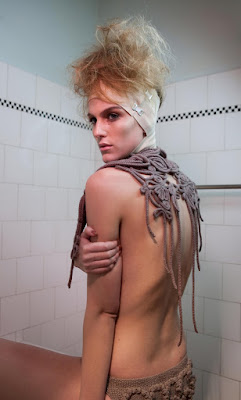
Shoulder wrap

How do you think wearability, functionality and aesthetics play out in Visible Markings?
All of the pieces created are wearable to some degree. What I was hoping to achieve by creating the pieces was challenge how fashion has been traditionally been viewed on the body. I am interested in components of fashion, such as gloves, neck and shoulder pieces etc, rather than whole garments. I guess this all ties in with the research that I have undertaken regarding the perceptions of knitting and how is should work on the body. It is interesting that a lot of people still view knitting as something that should be completely function (wearable) and offer protection and comfort. I do try to think of all the pieces individually and how they will work on the body, plus the messages that they can convey, but I suppose there are more pieces that say a lot more than others, such as arm sling (pictured below).

Arm sling

Who inspires you?
I am inspired by artists such as Caroline Broadhead who works with knitting as a medium. Her work utilises a variety of materials such as human hair etc. to create messages that repulse, but also intriguing. Liz Collins is another designer who I admire. Her work involves knit and fabric together and plays with process of shrinkage. The technique of making that she uses allows her to combine a variety of textures and weights which challenge the silhouette and how a garment works on the body.

Another reference is Rei Kawakubo (Comme des Garçons), while her work is not always knitted, I am fascinated with how she deconstructs the notions of fashion and how garments should be seen on the body. Vivienne Westwood also always challenges knit. She has a fascinating way of borrowing traditional stitch patterns and reinventing them, such as Argyle knit.

Neck pods

What is your favourite yarn to work with, and do you have a favoured technique of knitting?
I enjoy working with Australian wool. It has these amazing qualities in that you can mould it, manipulate it. Knitting with wool on a knitting machine is enjoyable, as it can be distorted/manipulated as you knit. You can adjust the tension, transfer stitches, catch stitches, drop stitches, and due to the slight elasticised quality, can be steamed after kitting and manipulated in/or out of shape.

Knitting the tucks as in the neck pods (pictured above) is an interesting process. It involves endless counting of stitches, catching them up to make the tuck and 'short row' knitting (which is a method of partially knitting an area of a garment, such as what you see in socks -heels and toes). All the pieces are fully fashioned, and the process that I go through to design and make the pieces, involves firstly draping knitted lengths of cloth on a mannequin. From here I manipulate and cut it away to form a shape or silhouette, and then once I have what is referred to as a toile, I then can created the paper knit patterns, which I draft on graph paper to scale.

So the process of making can be very time consuming, especially since I still work by hand. Some of the pieces I sometimes machine knit, and will also create a hand knitted version. It is interesting seeing the differences, just using a different process of making.Machine knitting tends to be quite even, while hand knitting, can be a bit more uneven and a bit softer to handle.
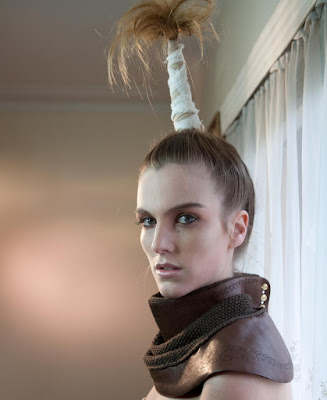
Collar

And finally, what is your idea of a perfect setting for knitting?
Anytime I have free time is great for knitting! I generally work from home and set the knitting machine up in the kitchen so I see everything that is going on! I do need a clear space and head to knit, but enjoy knitting at any time of the day or evening. I do like to start and finish a project, rather than have multiple projects on the go, this way, I can solely focus on making the one pieces, without becoming too influences by other ideas or techniques.

Alana's exhibition is on in Gallery 3 until Saturday 25 August.

To view more images of her exhibition Visible Markings, click here.

Pantone Pom Pom - a show with 'Pom-ise'

Last Monday, we wrote about CVHQ's beloved Assistant Retail Manager #2 Anita Cummins' first solo exhibition at Mailbox 141 entitled Pantone Pom Pom. The exhibition opened in the stairwell of 141 Flinders Lane with much fanfare and hoorah, to the amusement of a few passers-by. It's amazing the number of people you can fit in there!

We'll have some shots of Anita's show on the blog very soon, but in the meantime have a peek at the installation process (which was assisted by yours truly!)


Surprise installation

Anita's exhibition opened on Tuesday 30 June and will run until Saturday 22 August. Pantone Pom Pom is one of two satellite exhibitions taking place as part of our inaugural festival and cultural program, Craft Cubed. The first half of the exhibition will see a spectrum of colours in each of the 19 mailboxes. Midway through the show, Anita will be changing over the palette to a more tonal colour scheme - stay tuned for that!

In other news, keen-eyed readers may have noticed Michi Girl's snappy writeup on Anita's exhibition. Thanks for the love Michi!


(click to enlarge)

Hoorah indeed!

Craft Hatch update! Movie giveaway

This just in!

We've received a bundle of 2-for-1 movie passes to Michelle Pfeiffer's latest film Chéri thanks to our sweet connections. These passes are valid for the entire theatrical screening of the film and will be available for collection at the Craft Hatch market this Saturday.

About the film:

"Set in the luxurious demi-monde of pre-First World War Paris, CHÉRI is the story of the love affair between the beautiful retired courtesan Léa (Michelle Pfeiffer) and Chéri (Rupert Friend ), the son of her old colleague and rival, Mme Peloux (Kathy Bates). Léa has educated the spoilt and callow boy in the ways of love, but after six years Mme Peloux has secretly arranged for Chéri to marry the daughter of another rich courtesan. As the inevitable moment of parting approaches, Léa and Chéri begin to understand, too late, how much they mean to one another."

As if you needed one more reason to come to the market this Saturday...*


*don't forget, it's from 11am-4pm at the City Library on Flinders Lane

Craft Hatch in July: this Saturday!


Hamish and Betty by Kate Brereton

This Saturday get ready for the July edition of Craft Hatch! To be held at our regular spot in the Gallery at the City Library, this month Craft Hatch welcomes fresh new artists Kate Brereton of softie label Hamish and Betty, illustrator Charlotte Tizzard of Cserpent Art, jewellery students from NMIT's Product Design course, knitwear designer Paola Delgado and accessories maker Rebecca Wadge of Scarlet Designs.

They will be joining several Craft Hatch familiar faces including jewellers Deirdre Hoban & Jasmine Targett, stationer Kim McGeachin and her label Moose and Me, cuddly toys from Fontok's Myf Kemp, unisex jewellery label Does Not Equal by Charisse Black, students from Box Hill TAFE Jewellery, Lisa Engelhardt of textile label Orchis Morio and furniture makers Studio Hip (who currently are part of enCOUNTER exhibition Fully Furnished, which is part of the State of Design festival).

Phew! What a mouthful.

Here's a peek at what lies in store for you come Saturday:

Studio Hip by Damien Hipwell and Jacqueline Cuijpers

Fontok by Myf Kemp

Alpaca knitwear by Paola Delgado

Box Hill TAFE jewellery students

Scarlet Designs by Rebecca Wadge

NMIT Product Design - pencil necklace by Karla McEachern

Orchis Morio by Lisa Engelhardt


Moose and Me by Kim McGeachin

Cserpent Art by Charlotte Tizzard

Deirdre Hoban


Jasmine Targett


Does Not Equal by Charisse Black

To recap, Craft Hatch in July will take place this Saturday between 11am and 4pm at the Gallery on Level 1 at the City Library, 253 Flinders Lane.


Craft Hatch in July... because it's better than Christmas in July!

Congratulations!

Bling.

We've been a bit preoccupied with deadlines galore (that would be Craft Cubed and Craft Hatch), new exhibitions (enCOUNTER's Fully Furnished, which is part of the State of Design festival) and memberships (happy EOFYS everyone!) but we've finally had a moment to breathe and we'd like to take this moment to say

Congratulations!

To Stephanie, COUNTER's lovely Assistant Retail Manager, on her recent tying-of-the-knot with her partner/beau/best friend. Wishing you the warmest and happiest of wishes Steph! All of us here are so happy for you and congratulate you on your joyous day. Also, thanks for giving us an excuse to pig out on some pear tart!

We wish you all the happiness in the world Steph, and then some.

The World of Small Things

Our current exhibition The World of Small Things here in Gallery 1 is a lovingly curated affair. Put together by former Craft Victoria Director Kevin Murray, the exhibition is an exploration of collaborative work between Australian makers and the rest of the world. A creative pen-pal if you like!

Some of the collaborations include glassworker Jonathan Baskett's partnership with Mexican glass workshop Nouvel Studio, ceramacist Janet DeBoos' collaboration with the Huaguang Zibo Bone China factory in Shandong and Cheryl Adam's plastic florettes made by Filipino 'bat people', a term used to describe the impoverished population in Manila.

Bowls produced by Jonathan Baskett in Nouvel Studio, a Mexican glass workshop, while in the process of designing $2,500 bottles of tequila.

Teapot designed by Karl Millard while working with Ravissant, an Indian silverware company.

And now the exhibition description:

From outside Australia, from places we sometimes fear, come ingenious and finely crafted objects. And from inside Australia, objects are being designed and made for the growing markets in India and China.

The world is turning inside out. The global financial crisis has set the world in flux, enabling new relations between rich and poor countries. The collapse of an over-leveraged financial market helps us appreciate the immediacy of hand-crafted objects. These 'small things' bypass the rarefied world of brands and the politics of trade restrictions. New craft-design collaborations herald an era of partnership between rich and poor countries, urgently needed for the success of the Kyoto Protocol.

Underneath the complex web of international relations is a free flow of precious things; objects from Palestinian refugee camps in Southern Lebanon, the Kashmir, Iran, India, Mexico, Philippines, East Timor, Rwanda and Papua New Guinea.

How much does the origin of an object contribute to its value? Can craft connect cultures in ways that formal diplomacy can't? What are we purchasing when we buy an object made by a community that we support morally? These are questions that designer-makers of the world pose for us today.

Swamp grass (papyrus) jewellery by German jeweller Martina Dempf in collaboration with Rwandan weavers Dafan Mukantabashwa, Virginie Uwizeyimana, Pelagie Nyirahabineza, Alphonsine Urayeneza and Valentine Nyirakimonyo.

Participants include Cheryl Adam, Souad Amin, Jonathan Baskett, Cath Braid, Janet deBoos, Martina Dempf, Carole Douglas, Hlengiwe Dube, Judy Frater, Cathy Kata, Karl Millard, Asfaneh Modiramani, Sara Niner and Sara Thorn. Curated by Kevin Murray.

The World of Small Things is part of 2009 State of Design Festival’s public and cultural program, Design for Everyone.


Bags made from plastic bags made by Tejsi Dhana (India) and his family of the Megwhal community known for Kharad traditional weaving. Produced in collaboration with Carole Douglas (Australia).

To view more images from the exhibition, visit our Facebook album.


The World of Small Things runs until 25 July.

Introducing... Emma Davies


To round up the week, CLOG is proud to feature current Gallery 2 exhibitor Emma Davies. Her exhibition Morphed is a reflection of her time spent in Johannesburg which she visited in October 2007 as part of The South Project's Johannesburg Gathering event.

Morphed is also currently featured in 'Collector', our new section on the website that presents distinctive artworks from current exhibition programs. The aim is to help ensure these major craft and design works are collected. We're always looking out for you!

If you missed Emma's recent segment on ABC's Sunday Arts program, you can now view it by clicking here. Just in case, it's episode 17 and Emma's feature begins about 29 minutes into the show. As we said, always looking out for you!

Happy Friday everyone. Till next week.


The work in Morphed was inspired by your recent trip to Johannesburg. Could you please tell us about your experience?
My involvement with the South Project in October 2007 to South Africa was a wonderfully inspiring experience. We were fortunate to be able to exchange ideas with other practicing artists, hear their challenges with producing art in their environment and be exposed to fascinating performances and visual delights. I facilitated a workshop in Soweto with local art and craft enthusiasts and talked at the Craft Council in Johannesburg on creative living in the south-sustainable craft, design and visual art.


What was the most memorable moment during your trip?
The medicine market in Johannesburg was quite an overwhelming place, full of animal bones, skulls and skins which were difficult to look at but intriguing at the same time. [There were also] lots of small bottles containing mysterious and bizarre contents. There were many memorable moments but the market seemed to be a big inspiration for this body of work

Could you please tell us about the reasons behind the names of the sculptures?
As the sculptures don’t represent a particular person they were difficult to name, however I hope they express a feeling or an emotion and so I selected South African names for their meanings not the name particularly.

Your previous work usually has a much brighter colour palette but with Morphed, the palette is much darker and more subdued. Could you please expand upon this?
This body of work represents my trip to Soweto and what Morphed from that trip and experience there, I wanted the body of work to be strong therefore the use of one colour makes for a bold body of work. It is nothing like my previous work although it is still organic in its form, it’s good to have a change and not use colour although the red feathers represents a very small touch of all the colour in south Africa, it is a very colourful place, I did not present that in this work but its there. The black polypropylene material is commonly used for mussels and oysters.

Initially you began working with other plastics like fibreglass and polyester resin before moving on to polypropylene. What draws you to these plastic materials and what is polypropylene like to work with?
I wish I wasn’t drawn to plastics, I would rather be working with something much more organic but I have stumbled across this medium and enjoy the results I get from it. It is not as toxic to work with as resin and fibreglass however you still need to protect yourself from it. It’s not an easy medium to work with but I enjoy the exploration and experimentation.

What is your proudest achievement to date?
Achieving a career as an artist whilst being a mother

What was your first job?
Working at a fish and chip shop.

And finally, what is the best piece of advice anyone has ever told you?
Do whatever it is that makes you happy and pick my fights with my daughter.


To view more images of Emma's work, visit our past post on the show. Morphed is on until 25 July so you've still got a few weeks to hop to it.

Craft Hatch in June


A few weeks ago, Craft Hatch was back at the City Library for the June edition. With a nice balance of 5 new makers and 6 familiar faces, the June Craft Hatch was chock-full with pretty handmade things galore!

Here's a peek at the who, what, where and when of the June Craft Hatch...


Pezimystic handwoven bangles and other pretty things by Penny Walker-Keefe (pictured top and above).

The most beautiful dress by RMIT Fashion student Verity Copland. The effect on the fabric was created by using onion skins to dye the dress - how amazing is that!

Introducing Prudence Rees-Lee's (of PHILOS-o-FACE fame) new label Prudence and Horatio . Prue has recently flown the coop to join the illustrious roster of stockists at COUNTER! Congratulations Prue.

Nancygirl by Sue Manski. This month Sue brought more of her fun accessories and stationery.

Market favourites Box Hill TAFE (Jewellery) were back and bigger than ever with more designs and products!


Delicious 'bagettes' by Sotiria Lantouris.

More delicate illustrations and one-off works from recent RMIT graduate Chloe Vallance. Chloe recently exhibited at Pigment Gallery, which is located just down the road from CVHQ in the Nicholas Building. We hope you managed to catch this bright star!


Beautiful cosy knitwear by Teresa Bennett - perfect for the colder months ahead.

This month we also welcomed Jess Racklyeft and Stacey Kersting with their wonderful array of button rings (found through fossicking in foreign markets), illustrated cards and prints.

Thicket by Corinne Thomas. Corinne had some absolutely lovely egg and mug warmers on display, all lovingly hand-knitted of course.

Lovely brooches, earrings and fabric necklaces from Jen Hall. We'd like to offer Jen the heartiest of congratulations on her impending wedding. We wish you all the happiness in the world Jen!

Expect more coverage on the upcoming July Craft Hatch next week. We'll also be announcing the participants of the August Craft Hatch and Craft Hatch @ MWF markets very soon as well - events that we're just so excited about. It just gets better and better doesn't it!

Search This Blog

Followers